
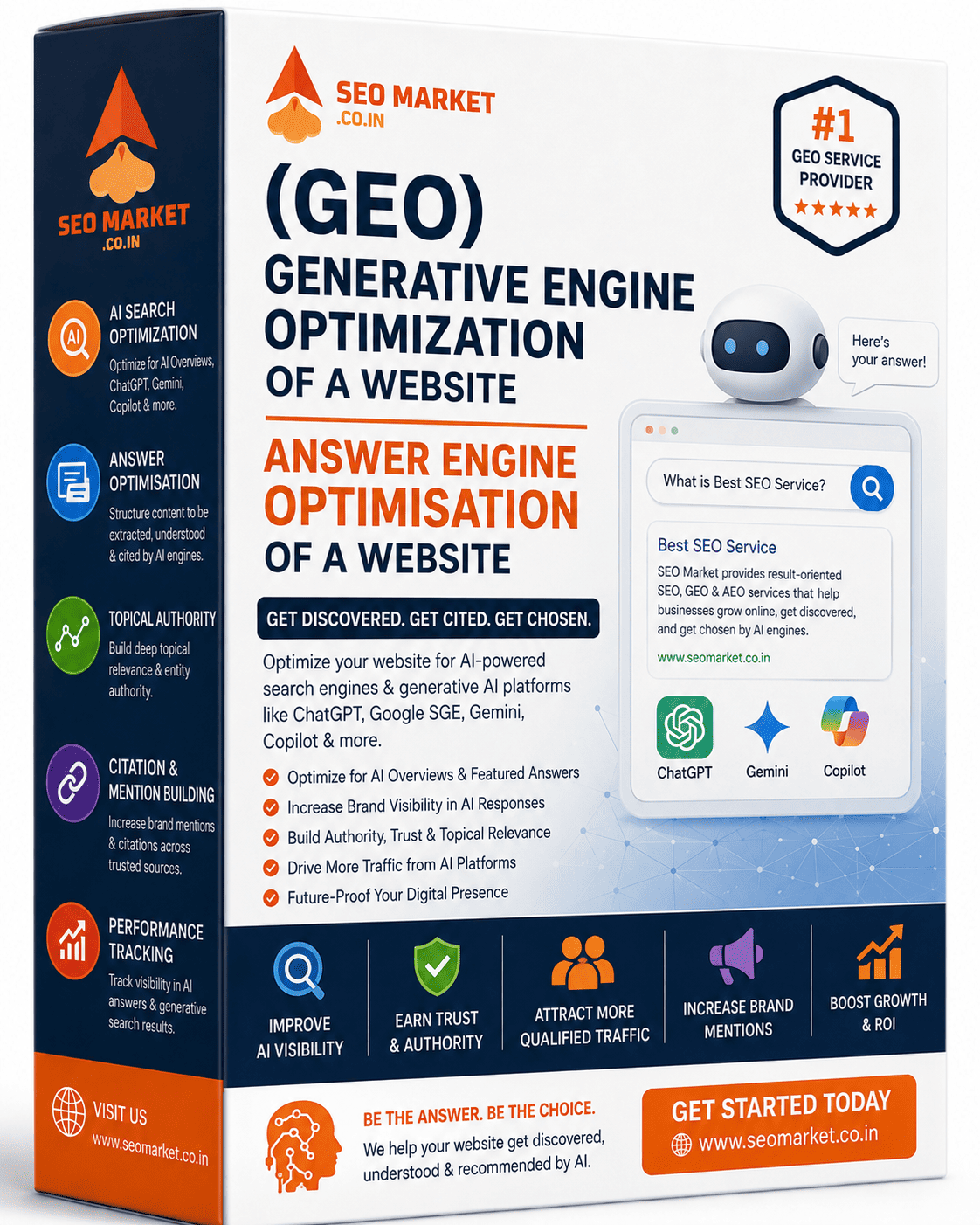
GEO & AEO Services USA
Get Your Brand Found in ChatGPT, Google AI, Gemini & Perplexity
Increase your chances of being cited, mentioned and recommended when potential customers ask ChatGPT, Gemini, Perplexity and Google AI about your industry.
🤖 GEO & AEO SEO Packages USA
| Feature | GEO Starter | GEO Growth ⭐ | GEO Dominator | GEO Enterprise |
|---|---|---|---|---|
| One-Time Setup | $499 | $799 | $1,299 | Custom |
| Monthly Price | $699/mo | $1,099/mo | $1,799/mo | $3,499+/mo |
| AI Queries Tracked | 30 | 75 | 150+ | 300+ |
| Search Engines / AI Platforms | 3 | 5 | 7+ | 10+ |
| Pages Optimized | 5 | 10 | 20 | 40+ |
| AI Answer Content | 5 | 10 | 20 | 40+ |
| FAQ Optimization | ✓ | ✓ | Advanced | Enterprise |
| AEO Optimization | ✓ | ✓ | Advanced | Enterprise |
| GEO Optimization | ✓ | ✓ | Advanced | Enterprise |
| AI Overview Optimization | ✓ | ✓ | ✓ | Advanced |
| ChatGPT Visibility | ✓ | ✓ | Advanced | Enterprise |
| Gemini Visibility | ✓ | ✓ | Advanced | Enterprise |
| Perplexity Visibility | ✓ | ✓ | Advanced | Enterprise |
| Copilot Visibility | — | ✓ | ✓ | Enterprise |
| Entity Optimization | Basic | ✓ | Advanced | Enterprise |
| Brand Mention Strategy | — | ✓ | ✓ | Advanced |
| Citation/Source Building | ✓ | ✓ | Advanced | Enterprise |
| Schema Optimization | ✓ | ✓ | Advanced | Enterprise |
| E-E-A-T Optimization | Basic | ✓ | Advanced | Enterprise |
| Topical Authority | Basic | ✓ | Advanced | Enterprise |
| Digital PR | — | Basic | ✓ | Advanced |
| AI Competitor Analysis | Basic | ✓ | Advanced | Enterprise |
| Traditional SEO Integration | — | ✓ | ✓ | ✓ |
| Monthly AI Visibility Report | ✓ | ✓ | ✓ | Executive |
| Strategy Call | — | Monthly | Monthly | Bi-weekly |
1. GEO Starter
$499 Setup + $699/month
For small businesses that want to start appearing in AI-generated answers.
Includes:
- 30 AI/search queries tracked
- 5 website pages optimized
- 5 AI-answer content blocks
- AEO optimization
- GEO optimization
- FAQ optimization
- Schema implementation
- Entity optimization
- Basic E-E-A-T improvements
- ChatGPT visibility tracking
- Google AI visibility tracking
- Gemini visibility tracking
- Perplexity tracking
- Basic citation strategy
- AI competitor analysis
- Monthly AI visibility report
Best for: SMBs, local businesses, consultants, agencies and startups.
2. GEO Growth ⭐
$799 Setup + $1,099/month
Includes everything in Starter, plus:
- 75 AI queries tracked
- 10 pages optimized
- 10 AI-answer content assets
- Advanced AEO
- Advanced GEO
- Google AI Overviews optimization
- ChatGPT optimization
- Gemini optimization
- Perplexity optimization
- Microsoft Copilot optimization
- Entity/Knowledge Graph optimization
- Brand mention strategy
- Citation/source optimization
- E-E-A-T improvements
- Author/entity optimization
- Topical authority development
- AI competitor gap analysis
- Digital PR opportunities
- Traditional SEO + GEO integration
- Monthly strategy call
3. GEO Dominator
$1,299 Setup + $1,799/month
For established businesses that want serious AI search visibility.
Includes:
- 150+ AI queries
- 20 website pages optimized
- 20 AI-answer content assets
- Advanced AEO
- Advanced GEO
- AI Overview optimization
- ChatGPT
- Gemini
- Perplexity
- Copilot
- Claude/other relevant AI platforms
- Entity optimization
- Knowledge Graph strategy
- Brand/entity authority
- 20+ citation opportunities
- Topical authority
- E-E-A-T
- Expert/author optimization
- Digital PR
- Brand mention campaigns
- AI competitor intelligence
- Advanced schema
- Traditional SEO integration
- AI visibility monitoring
- Citation-share tracking
- Monthly strategy meeting
- Executive report
4. GEO Enterprise
$3,499+/month
For large brands, national companies, SaaS companies, eCommerce businesses and multi-location organizations.
Includes:
- 300+ AI queries
- 40+ pages optimized
- 40+ AI-answer content assets
- 10+ AI platforms
- Enterprise entity optimization
- Knowledge Panel strategy
- Knowledge Graph optimization
- Large-scale topical authority
- AI citation strategy
- Digital PR
- High-authority brand mentions
- Expert/author authority
- Enterprise schema
- AI competitor intelligence
- Multi-market GEO
- Multi-location GEO
- Traditional SEO + GEO + AEO
- Advanced AI visibility dashboard
- Citation/share-of-voice monitoring
- Dedicated strategist
- Bi-weekly strategy meetings
🔥 High-Margin GEO Add-ons
| Add-on | Price |
|---|---|
| GEO Page Optimization | $99/page |
| AEO Page Optimization | $99/page |
| AI Answer Content | $99 |
| Premium AI-Optimized Article | $149 |
| Expert/E-E-A-T Article | $199 |
| AI Query Research — 50 Queries | $149 |
| AI Query Research — 100 Queries | $249 |
| Entity Optimization | $199 |
| Brand Mention Campaign | $299/mo |
| AI Citation Campaign | $299/mo |
| Digital PR | $499+ |
| AI Competitor Analysis | $199 |
| Schema Optimization | $149 |
| Knowledge Panel Strategy | $299 |
| AI Visibility Monitoring | $199/mo |
| Additional Location | $299/mo |
| Traditional SEO Integration | $399/mo |
🤖 GEO / AI Visibility Audit
$199 One-Time
Audit includes:
- ChatGPT visibility test
- Gemini visibility test
- Perplexity visibility test
- Google AI visibility
- AI query research
- Competitor AI visibility
- Brand/entity analysis
- Citation/source analysis
- Website content analysis
- AEO analysis
- GEO analysis
- E-E-A-T analysis
- Schema analysis
- Topical authority analysis
- Brand mention analysis
- AI content gap
- 90-day GEO roadmap
What Is AEO SEO and Why Does It Matter in the USA?
AEO SEO stands for Answer Engine Optimization. It is the process of optimizing content so that search engines, AI assistants, and answer platforms can directly understand and present your information as an answer to users’ questions.
Traditional SEO focuses on ranking webpages in search results. AEO focuses on becoming the actual answer shown in:
- Google Featured Snippets
- AI search results
- Voice assistants
- Chatbots
- Google’s “People Also Ask”
- AI-generated summaries
- Smart devices and voice search platforms
In the USA, AEO is becoming extremely important because users are increasingly searching using conversational questions instead of short keywords.
For example, instead of searching:
- “HVAC Dallas”
Users now ask:
- “Who is the best HVAC contractor in Dallas?”
- “How much does AC repair cost in Texas?”
- “What is the fastest way to cool a home during summer?”
AI-powered search engines try to provide direct answers instantly. Businesses that optimize for AEO are more likely to appear in these answer boxes and AI-generated responses.
Difference Between SEO and AEO
Although SEO and AEO work together, they are not exactly the same.
| Traditional SEO | AEO SEO |
|---|---|
| Focuses on webpage rankings | Focuses on direct answers |
| Targets keywords | Targets user questions |
| Optimizes for clicks | Optimizes for visibility and authority |
| Designed mainly for search engines | Designed for AI systems and answer engines |
| Relies heavily on backlinks | Relies heavily on structured content and clarity |
Modern digital marketing in the USA now requires both SEO and AEO together.
Why AEO Is Growing Fast in the USA
The USA is one of the largest digital markets in the world. AI-driven search behavior is changing rapidly due to:
- Increased mobile usage
- Voice search adoption
- AI assistants
- Smart speakers
- ChatGPT-style search experiences
- Google AI Overviews
American consumers increasingly expect quick, direct answers rather than browsing multiple websites.
Industries heavily affected include:
- HVAC
- Legal services
- Medical clinics
- Real estate
- Finance
- Home services
- eCommerce
- Travel
Businesses that fail to optimize for AEO may lose visibility even if they rank well traditionally.
How AEO Works
Answer engines use artificial intelligence and natural language processing (NLP) to understand:
- User intent
- Question context
- Semantic meaning
- Authority signals
- Structured information
Instead of simply matching keywords, AI systems evaluate whether your content clearly answers a question.
For example:
Weak SEO Content
“Dallas HVAC services provide excellent heating solutions.”
Strong AEO Content
“The average HVAC repair cost in Dallas ranges from $150 to $600 depending on the issue, system size, and emergency service requirements.”
The second example directly answers a user query, making it more useful for AI search systems.
Key Elements of AEO SEO in the USA
1. Question-Based Content
AEO content should answer real customer questions.
Examples:
- What is HVAC SEO?
- How much does SEO cost in the USA?
- What is the best CRM for small businesses?
- How long does local SEO take?
Question-focused content performs very well in answer engines.
2. Featured Snippet Optimization
Google often displays short answer boxes at the top of search results.
To optimize for snippets:
- Use clear headings
- Answer questions directly
- Keep answers concise initially
- Use lists and tables
- Add structured formatting
Example:
What Is Local SEO?
Local SEO is the process of optimizing a business to appear in location-based searches such as “dentist near me” or “best plumber in Chicago.”
This format is ideal for featured snippets.
3. Schema Markup
Schema markup helps search engines understand your content better.
Important schema types include:
- FAQ schema
- Local business schema
- Review schema
- Product schema
- Service schema
- Article schema
Schema increases the chances of appearing in rich results and AI-generated answers.
4. Voice Search Optimization
Voice searches are highly conversational.
Americans commonly use voice search while driving, cooking, or using smart devices.
Examples include:
- “Where can I find emergency HVAC repair near me?”
- “What is the best SEO agency in Texas?”
- “How do I improve website rankings?”
Voice search optimization requires natural language content.
5. Topical Authority
AI systems prefer authoritative websites that cover topics deeply.
For example, an HVAC company should create content around:
- AC repair
- Furnace installation
- HVAC maintenance
- Indoor air quality
- Energy efficiency
- Thermostats
- HVAC costs
The more comprehensive your content ecosystem, the stronger your authority becomes.
AEO for Local Businesses in the USA
Local businesses benefit greatly from AEO because users often search for immediate answers.
Examples:
- “Best emergency plumber in Miami”
- “Top HVAC contractor in Dallas”
- “Affordable dentist in Chicago”
To improve local AEO:
- Optimize your Google Business Profile
- Add FAQs
- Use location-based keywords
- Collect customer reviews
- Create city-specific landing pages
Industries Winning with AEO in the USA
HVAC Companies
Customers search emergency questions frequently. HVAC businesses using FAQ-rich content often appear in answer results.
Law Firms
Legal searches are highly question-based:
- “What should I do after a car accident?”
- “How much does a divorce lawyer cost?”
Medical Clinics
Patients search symptoms and treatment information constantly.
Real Estate
People ask:
- “Best neighborhoods in Dallas”
- “How much are homes in Miami?”
Finance
Financial questions dominate AI search traffic.
Best Practices for AEO SEO
Write Clearly
AI systems prefer simple, direct language.
Use Headings Properly
Questions should appear naturally in headings.
Add FAQ Sections
FAQ pages are excellent for answer optimization.
Create High-Quality Content
Thin content rarely appears in AI answers.
Improve Website Speed
Fast websites improve user experience and rankings.
Build Authority
Backlinks and brand mentions still matter.
Does AEO Replace Traditional SEO?
No. AEO complements SEO rather than replacing it.
Traditional SEO still matters for:
- Rankings
- Organic traffic
- Backlinks
- Domain authority
- Website visibility
However, AEO is becoming essential because AI-driven search is growing rapidly in the USA.
Businesses combining both strategies gain the best results.
Future of AEO in the USA
The future of search is becoming increasingly AI-driven.
Platforms such as:
- Google AI Overviews
- AI chat assistants
- Voice assistants
- Conversational search engines
are changing how Americans find information online.
This means businesses must optimize not only for search rankings but also for direct answer visibility.
Companies adapting early to AEO can gain significant competitive advantages.
Final Thoughts
AEO SEO (Answer Engine Optimization) is the next evolution of digital visibility. In the USA, users increasingly expect immediate, accurate answers from AI-powered search systems and voice assistants.
While traditional SEO helps websites rank, AEO helps businesses become the trusted answer users see first.
Successful AEO strategies include:
- Question-based content
- Structured data
- Voice search optimization
- FAQ content
- Clear and direct answers
- Topical authority
For businesses in competitive American markets, combining SEO and AEO is becoming one of the smartest long-term digital marketing strategies.
🔍 1. SEO (Search Engine Optimization)
This is the foundation.
SEO = optimizing your website so it ranks on search engines like Google.
Core parts:
- On-page SEO → keywords, content, headings
- Off-page SEO → backlinks
- Technical SEO → speed, mobile, indexing
Goal:
👉 Rank higher on Google search results
👉 Get organic traffic
📍 2. GEO (Generative Engine Optimization)
This is new-age SEO for AI-driven answers.
GEO = optimizing your content so AI tools like ChatGPT, Google Gemini, and Microsoft Copilot pick your content in their answers.
How it works:
AI doesn’t just rank websites — it extracts answers.
So you optimize for:
- Direct answers (clear, structured content)
- FAQs
- Authority (E-E-A-T)
- Citations & mentions across web
Example:
Instead of writing:
“SEO is important…”
You write:
“SEO typically takes 3–6 months to show results depending on competition.”
👉 This gets picked by AI answers.
🤖 3. AIO (AI Optimization / AI Integration Optimization)
This is broader than GEO.
AIO = optimizing your entire digital presence for AI-driven platforms + automation
Includes:
- GEO (AI content optimization)
- AI chatbots on website
- Personalized AI funnels
- AI-driven ad targeting
- Content automation
Goal:
👉 Not just traffic
👉 But conversion using AI
⚔️ SEO vs GEO vs AIO (Simple View)
| Factor | SEO | GEO | AIO |
|---|---|---|---|
| Focus | Google ranking | AI answers | AI ecosystem |
| Traffic source | Search results | AI tools | Multi-channel |
| Strategy | Keywords | Answers + authority | Automation + AI |
| Future relevance | High | Very high | Explosive |
💡 Practical Strategy (for YOU)
Since you’re already into SEO services, here’s the real opportunity:
1. Combine SEO + GEO
- Write blog posts
- Add FAQ sections
- Use question-based headings
2. Target AI queries
People now ask:
- “Best SEO services in India?”
- “SEO kitne time me result deta hai?”
👉 Create content answering these EXACTLY.
3. Build “AI-friendly authority”
- Publish case studies
- Get brand mentions
- Use structured data
4. Sell it as a service 💰
You can literally create a new package:
“AI SEO / GEO Package”
- AI-optimized content
- FAQ schema
- Featured snippet targeting
- AI visibility tracking
👉 Price it higher than normal SEO (less competition right now)
🚀 Reality Check
If you ignore GEO/AIO:
👉 You’ll rank on Google
👉 But lose traffic to AI answers
If you adopt early:
👉 You become the source AI pulls from
📍 GEO (Generative Engine Optimization) – The Future of Search in 1000 Words
Generative Engine Optimization (GEO) is the next evolution of digital visibility, emerging alongside the rapid rise of artificial intelligence tools like ChatGPT, Google Gemini, and Microsoft Copilot. While traditional Search Engine Optimization (SEO) focuses on ranking websites on search engines like Google, GEO is about optimizing content so that it gets selected, cited, and surfaced directly inside AI-generated answers.
This shift is fundamental. Instead of users clicking on blue links, they increasingly receive direct, conversational responses from AI systems. As a result, businesses must rethink how they create and structure content to remain visible in this new landscape.
🔍 What is GEO?
GEO refers to the process of designing and structuring digital content so that generative AI systems can easily understand, extract, and present it as part of their answers. Unlike SEO, where ranking position determines visibility, GEO is about being the source of truth that AI models rely on.
For example, when a user asks an AI tool, “How long does SEO take to show results?”, the AI doesn’t display ten website links. Instead, it generates a summarized answer based on multiple sources. GEO ensures that your content is one of those sources.
⚙️ How GEO Works
AI systems use large language models (LLMs) trained on vast datasets. They retrieve, synthesize, and generate responses by identifying high-quality, relevant, and trustworthy information.
To be selected, your content must meet certain criteria:
1. Clarity and Directness
AI prefers content that answers questions clearly and concisely. अस्पष्ट या लंबा घुमावदार content कम उपयोगी होता है.
2. Structured Information
Well-organized content with headings, bullet points, and FAQs is easier for AI to parse.
3. Authority and Trust (E-E-A-T)
Content that demonstrates Experience, Expertise, Authority, and Trustworthiness is more likely to be used.
4. Contextual Relevance
AI selects content that best matches the intent behind a query, not just keywords.
🧠 GEO vs Traditional SEO
While GEO and SEO overlap, they differ in key ways:
- SEO focuses on rankings; GEO focuses on answer inclusion
- SEO targets search engines; GEO targets AI models
- SEO relies heavily on keywords; GEO relies on meaning and context
- SEO drives clicks; GEO may reduce clicks but increase brand authority
This doesn’t mean SEO is obsolete. Instead, GEO builds on SEO. A strong SEO foundation increases the chances of your content being discovered and used by AI systems.
✍️ Key Strategies for GEO
To succeed with GEO, content creators and businesses must adapt their approach. Here are the most effective strategies:
1. Write for Questions, Not Just Keywords
Modern users interact with AI conversationally. Instead of targeting “SEO services India,” target questions like:
- “What are the best SEO services in India?”
- “How much does SEO cost in Delhi?”
Answer these questions directly within your content.
2. Use FAQ Sections
FAQ sections are extremely valuable for GEO. They provide clear, structured answers that AI can easily extract.
Example:
Q: How long does SEO take?
A: SEO typically takes 3 to 6 months to show measurable results, depending on competition and website quality.
3. Provide Precise, Data-Driven Answers
Avoid vague statements. AI prefers specificity.
Weak:
SEO takes time.
Strong:
SEO usually takes 90–180 days to deliver noticeable ranking improvements.
4. Build Topical Authority
Instead of writing random blogs, focus on becoming an authority in a niche. Cover all related topics deeply.
For example, if your niche is SEO:
- On-page SEO
- Off-page SEO
- Technical SEO
- Local SEO
- AI SEO (GEO)
This creates a strong knowledge graph around your website.
5. Optimize for Featured Snippets
Featured snippets often serve as training signals for AI models. Structuring content to win snippets improves GEO performance.
Use:
- Lists
- Tables
- Step-by-step guides
6. Strengthen Brand Mentions
AI doesn’t just rely on your website. It looks at your presence across the web. Mentions on blogs, directories, and social platforms increase credibility.
7. Use Structured Data (Schema Markup)
Schema helps search engines and AI systems understand your content better. FAQ schema, article schema, and local business schema are especially useful.
📊 Benefits of GEO
1. Visibility in AI Answers
Your content can appear directly in AI-generated responses, even if you’re not ranking #1 on Google.
2. Higher Authority
Being cited by AI tools builds trust and brand recognition.
3. Future-Proof Strategy
As AI adoption grows, GEO will become essential for digital success.
⚠️ Challenges of GEO
1. Reduced Click Traffic
Users may get answers without visiting your website.
2. Less Control
AI decides how your content is summarized and presented.
3. Measurement Difficulty
Tracking GEO performance is still evolving compared to traditional SEO metrics.
🚀 GEO in India and Local Markets
In markets like India, where mobile usage and voice search are growing rapidly, GEO has massive potential. Users often ask questions in natural language or Hinglish, such as:
- “SEO kitne time me result deta hai?”
- “Best digital marketing agency near me?”
Creating content that matches these patterns increases your chances of being selected by AI tools.
💼 Business Opportunity
For agencies and freelancers, GEO opens a new revenue stream. You can package it as:
“AI SEO Services” or “GEO Optimization”
- AI-friendly content writing
- FAQ optimization
- Authority building
- AI visibility tracking
Since competition is still low, pricing can be premium compared to traditional SEO services.
🔮 The Future of GEO
The future of search is shifting from “search and click” to “ask and receive.” AI tools will increasingly act as intermediaries between users and information.
Companies that adapt early will:
- Gain disproportionate visibility
- Build stronger authority
- Capture high-intent audiences
Those who rely only on traditional SEO risk losing relevance as AI becomes the primary interface for information discovery.
🧾 Conclusion
Generative Engine Optimization (GEO) is not just a trend—it is a fundamental shift in how information is discovered and consumed. By focusing on clarity, structure, authority, and user intent, businesses can position themselves as trusted sources in AI-generated answers.
Rather than replacing SEO, GEO enhances it. Together, they form a powerful strategy for the future of digital marketing. The key is to start early, experiment, and continuously refine your approach as AI technologies evolve.
If done right, GEO doesn’t just bring traffic—it makes your brand the answer.